
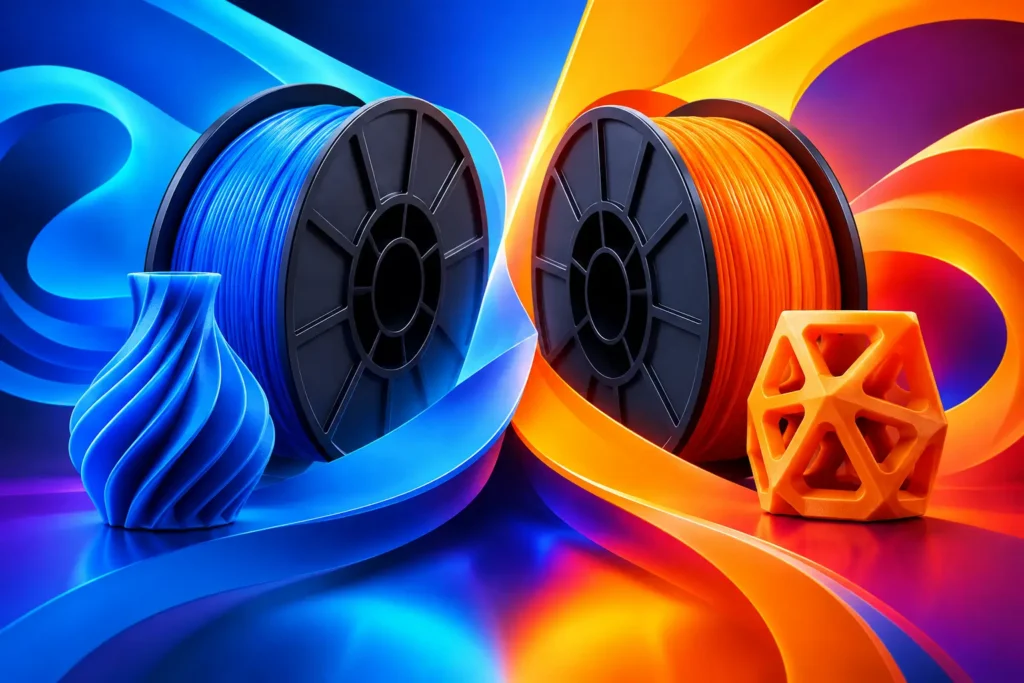
That bracket on your workbench, the custom controller mount, the clean-looking prototype you want to hand to a client – material choice decides whether it feels like a finished part or a temporary print. In the PLA Pro vs PETG debate, neither filament wins every build. The right choice comes down to how the part will be used, what kind of finish you want, and how much tuning you want to do before pressing print.
PLA Pro and PETG both sit above basic PLA for many makers, but they get there differently. PLA Pro is built for easier printing with more strength and toughness than standard PLA. PETG leans toward durability, heat tolerance, and resistance to everyday wear. Knowing where each material shines helps you spend less time reprinting and more time making parts that earn their place on the bench.
PLA Pro vs PETG: The Quick Difference
PLA Pro is usually the move when you want a strong, stiff, polished-looking print with straightforward setup. It is a smart material for display pieces, prototypes, organizers, enclosures that stay indoors, and functional parts that need crisp geometry without a long calibration session.
PETG is the better fit when the part needs to tolerate more impact, warmth, moisture, or regular handling. Think garage storage, shop fixtures, bottle holders, equipment guards, outdoor-adjacent accessories, and components that may get bumped, flexed, or exposed to occasional splashes.
Neither label tells the entire story. Formulations vary by brand, printer, nozzle, and spool condition. But as a practical rule, PLA Pro prioritizes print confidence and surface quality, while PETG prioritizes resilience in more demanding environments.
Strength Is More Than One Number
Makers often ask which filament is stronger, but strength has several meanings. A material can be very stiff yet crack under a hard hit. Another can bend and absorb impact without breaking, even if it does not feel as rigid in your hand.
PLA Pro generally offers excellent stiffness and improved toughness compared with standard PLA. A well-designed PLA Pro part can feel solid, hold sharp edges, and resist deformation under ordinary indoor loads. This makes it a strong contender for brackets, desk tools, display hardware, and prototype housings. It also tends to make dimensional details easier to hold, which matters when lids, inserts, or mating parts need to fit cleanly.
PETG is less stiff, but it is often more forgiving when a part gets knocked, squeezed, or dropped. It has a little more give before failure. That behavior is valuable for clips, mounts, guards, and utility parts where a brittle snap would end the project. If the part must flex slightly during use, PETG normally gives you more margin.
Part design still matters as much as material. Add fillets at sharp inside corners, orient layer lines to resist the expected load, and use enough walls before chasing extreme infill percentages. A poorly oriented print with 100% infill can fail faster than a well-designed part with sensible wall thickness.
Heat, Moisture, and the Real World
A part that lives on a desk has very different needs than one that lives in a hot car or near a sunny window. PLA Pro can handle everyday indoor use well, but it is not the best choice for high-heat environments. Heat can soften PLA-based materials enough to cause warping, sagging, or a permanent change in shape under load.
PETG has the advantage when temperatures climb. It is commonly chosen for items that may see warm garages, vehicles, utility areas, or proximity to warm equipment. It also handles moisture and many household chemicals better than PLA Pro, making it useful for practical containers, workshop accessories, and parts exposed to routine cleaning.
That does not make PETG invincible outdoors. Long-term UV exposure, temperature cycling, and mechanical load can still wear down any printed part. For safety-critical, high-temperature, or highly chemical-exposed applications, evaluate the actual service conditions instead of assuming a spool label solves the problem.
Printability: Easy Wins vs Extra Durability
PLA Pro is one of the easiest ways to get a print that looks intentional on a consumer or prosumer machine. It usually has low warp, reliable bed adhesion, crisp overhang performance, and a smooth finish. For makers building a new printer profile or producing a batch of polished parts, those traits add up fast.
PETG asks for more patience. It can string, leave small blobs around travel moves, and behave differently from one printer setup to another. It also likes to stick aggressively to some print surfaces. A release layer or compatible build plate setup can prevent the part from bonding too hard to the bed.
The reward is a tough, useful part, but PETG works best when you dial in temperature, retraction, cooling, and first-layer settings. Dry filament matters for both materials, yet PETG is especially likely to show moisture problems as popping, rough surfaces, or extra stringing. If a PETG print suddenly looks messy, drying the spool is often a better first move than endlessly changing slicer settings.
Start with the temperature range recommended for your specific filament and tune in small steps. With PETG, avoid treating high fan speed as an automatic fix. Moderate cooling often improves layer bonding while keeping details respectable. With PLA Pro, stronger cooling can help preserve overhangs and sharp features, though every printer has its own sweet spot.
Surface Finish and Color Matter
For models, presentation prototypes, and parts you want to look clean right off the bed, PLA Pro has a clear edge. It typically delivers a more matte or satin finish, sharper text, and less visible stringing once the profile is set. That makes colors like Black, White, Red, Ash Grey, and Sky Blue feel ready for a finished build rather than a rough draft.
PETG often has a glossier appearance. That can look great on transparent parts, translucent accents, and functional prints where a smooth, durable surface is the point. But gloss also highlights layer inconsistencies, travel marks, and small blobs. A dialed-in PETG print can look excellent, but it does not hide weak settings as easily as PLA Pro.
If visual consistency is your first priority, choose PLA Pro. If the finish can be a little more industrial because the part needs to take real-world abuse, PETG is a confident choice.
Choose the Filament by the Job
Use PLA Pro when the build needs stiffness, detail, a clean finish, and simple printing. It is especially effective for indoor organizers, product mockups, display parts, gaming accessories, electronics enclosures away from heat, jigs, and general prototypes.
Choose PETG for parts that need to handle impact, heat, moisture, or frequent use. It is a strong option for workshop fixtures, protective covers, utility mounts, clips, planters, bottle accessories, and functional components that may spend time outside the comfort of a climate-controlled room.
A simple decision check can keep your next order focused:
- Choose PLA Pro if the part must look sharp, print easily, and stay indoors.
- Choose PETG if the part may get hot, wet, bumped, or flexed.
- Choose PLA Pro for detail-first prototypes and presentation pieces.
- Choose PETG for utility-first parts that need more environmental tolerance.
There is room for both materials in a serious maker setup. PLA Pro can be your fast, polished default for everyday printing. PETG can be the spool you reach for when the job demands a tougher answer.
Get Better Results From Either Material
Before committing to a long print, run a small test with the same wall count, orientation, and settings you plan to use for the final part. A short bracket or clip tells you more about layer bonding and flexibility than a generic calibration cube. Check fit, bend it by hand, and look at the layer lines under good light.
Also match your infill to the job. Decorative parts often need far less infill than makers expect, while functional parts gain more from additional walls and thoughtful geometry. Four or more walls can make a major difference in screw bosses, brackets, and housings without the print time penalty of filling the entire interior.
At Ddub Tech, the goal is simple: give makers material that helps turn a solid idea into a part worth keeping. Pick PLA Pro when clean execution matters most. Pick PETG when the part needs to keep showing up after the first hard day of use. Your printer can make either one work – the smart move is choosing the filament that matches the life your part is about to live.