
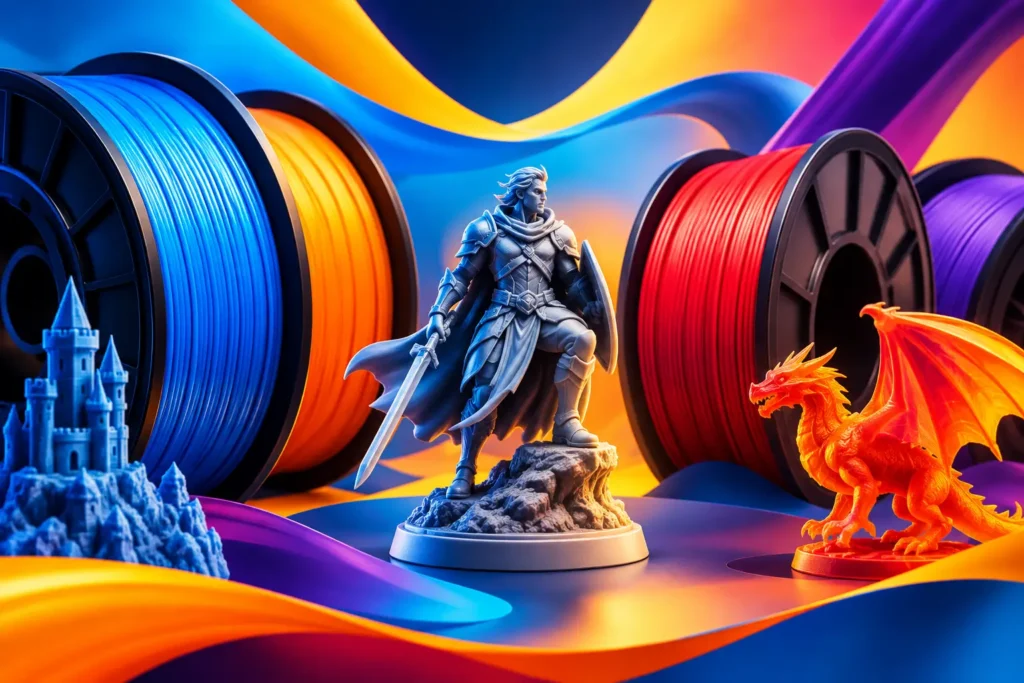
A miniature can have a perfect sculpt and still look disappointing when the material fights the printer. Soft edges, stringy weapons, weak ankles, and layer lines across a character’s face are rarely fixed by paint alone. Choosing the best filaments for miniatures gives you a cleaner starting point – and that means less sanding, less reprinting, and more time building an army, display piece, or custom design you are proud to put on the table.
For most FDM makers, the answer starts with PLA Pro. But the right filament depends on the miniature’s purpose, your printer setup, and how much post-processing you want to do. Here is how to choose with confidence.
Best Filaments for Miniatures at a Glance
PLA Pro is the top all-around choice for detailed miniatures. It prints cleanly at approachable temperatures, holds crisp features, and offers more toughness than basic PLA. Ash Grey, White, and Black are especially useful colors for checking surface detail before primer.
ABS is the stronger option for pieces that will take real handling, such as gaming terrain, articulated models, bases, or functional accessories. It needs more control than PLA Pro, including a properly heated bed and ideally an enclosure, but it rewards experienced makers with durable parts that can be sanded and finished well.
PETG works when you need impact resistance and a little flexibility, though it is not usually the first pick for tiny, highly detailed figures. TPU is even more specialized. It is excellent for flexible creature parts, tires, grips, or cosplay-scale details, but its softness makes clean miniature features harder to achieve.
The simple recommendation: use PLA Pro for characters and display models, ABS for durable game pieces and terrain, PETG for tough accessories, and TPU only when flexibility is the actual goal.
Why PLA Pro Wins for Most Miniature Prints
Miniatures are a detail test. Faces, chainmail, scrollwork, fingers, horns, and small weapon edges expose every weakness in a filament or slicer profile. PLA Pro gives most makers the best balance of printability, finish quality, and practical strength.
Compared with standard PLA, PLA Pro is formulated for better toughness. That matters when you are removing supports from a thin sword, snapping a model off its brim, or passing a painted figure around a game table. You still need to orient the model smartly, but the finished part is less likely to fail from ordinary handling.
It also works well at the small layer heights that miniatures demand. A 0.12 mm layer height is a reliable everyday target with a 0.4 mm nozzle. For faces, ornate armor, or centerpiece models, stepping down to 0.08 mm can improve vertical curves and reduce visible stepping. A smaller nozzle, such as 0.25 mm, can capture finer features, although print times rise quickly and tuning becomes less forgiving.
PLA Pro is also the low-drama material choice. It has minimal warping, does not require an enclosure, and is easier to run consistently on common consumer printers. That reliability is a big deal when a multipart terrain kit or set of troops needs ten, twenty, or fifty successful prints.
Choose Color for the Work You Plan to Do
Color affects how easily you can inspect a print. Ash Grey makes layer lines, support scars, and sculpted detail easy to see under normal lighting. It is a strong choice for display models that will be primed and painted. White is useful when you want bright colors to cover quickly after painting, while Black can hide minor surface texture on models that will remain unpainted.
Transparent filament can create great effects for spell blasts, crystals, water, or sci-fi energy parts. It is not the material to choose when you need every layer line to disappear, because transparent prints tend to reveal internal paths and surface variation. Use it as an effect material, not a default miniature filament.
When ABS Is the Better Move
ABS earns its place when durability matters more than effortless printing. A dungeon tile that gets assembled every weekend, a large dragon wing, or a travel-ready set of game components can benefit from ABS’s toughness and heat resistance.
It is also a practical material for makers who like to sand, fill, and refine a print. ABS responds well to post-processing, and its temperature resistance is useful for models that may sit in a hot car, workshop, or sunny display area. PLA Pro can soften under higher heat, so ABS is the safer choice for objects that will face rougher conditions.
The trade-off is warping. ABS shrinks as it cools, and that shrinkage can pull corners off the bed or split tall parts along layer lines. Use a heated bed, keep drafts away, and run an enclosure when possible. For miniature-scale figures, ABS can deliver excellent results, but it is usually not worth the extra setup unless you specifically need its performance benefits.
If you are printing ABS indoors, ventilation matters. Print in a well-managed space and follow the material and printer safety guidance for your setup.
PETG and TPU: Great Materials, Specific Jobs
PETG is tough, impact-resistant, and less prone to brittle breaks than PLA. That makes it useful for miniature storage inserts, bases, clips, terrain connectors, and functional pieces around your hobby setup. Its drawback is stringing. Fine hairs between limbs, weapons, and support structures can turn cleanup into a chore.
You can reduce PETG stringing with dry filament, conservative temperatures, tuned retraction, and fast travel moves. Even then, PLA Pro will usually produce a cleaner result for a 28 mm figure with delicate features. PETG is the right answer when toughness is non-negotiable, not when maximum visual sharpness is the mission.
TPU brings flexibility, but it is not a miracle detail filament. Flexible tentacles, rubber wheels, bendable straps, and protective feet are all smart uses. Tiny faces and thin decorative elements are not. TPU prints slowly and benefits from a controlled filament path, especially on Bowden-style printers. Save it for parts that need to bend, compress, or grip.
Material Is Only Half the Miniature Print
The best filament cannot rescue a rushed profile. Miniatures reward careful slicing more than almost any other FDM project. Start with a dry spool, a clean nozzle, and a bed that is properly trammed or mesh-leveled. From there, slow the outer walls enough for the printer to place detail accurately.
For many PLA Pro miniatures, outer wall speeds around 20 to 35 mm/s are a sensible starting range. Run a temperature tower if you are using a new spool or printer profile. Too hot, and fine details soften while strings build between features. Too cool, and layer adhesion can suffer.
Orientation deserves equal attention. Place the model so its most visible face and front-facing details avoid support contact. Tilt figures slightly backward when it helps keep supports off the chest, face, or shield. Tree supports can reduce scarring on organic shapes, while carefully placed manual supports often give better control on swords, capes, and delicate overhangs.
Do not chase tiny layer heights before your machine is calibrated. A clean 0.12 mm print with proper flow, pressure advance, retraction, and cooling will often look better than a poorly tuned 0.08 mm print. Consistency beats theoretical resolution.
A Smart Buying Strategy for Miniature Makers
Keep one dependable PLA Pro color on hand as your everyday material, then add specialty colors or materials as projects demand them. Ash Grey is an excellent workhorse for painting projects because it shows what the printer is actually doing. Black and White cover a wide range of unpainted models, props, and terrain. Transparent filament can wait until you are ready to add visual effects.
If you print game terrain or functional hobby parts often, keep ABS or PETG in the rotation. The best choice is not the filament with the longest feature list. It is the one that gives your project the right balance of surface quality, strength, cleanup time, and repeatability.
Ddub Tech PLA Pro is built for makers who want that dependable middle ground: stronger parts, a smooth finish, and reliable performance without turning every miniature into a troubleshooting project.
Your next miniature does not need a miracle material. It needs a filament that matches the job, a dialed-in profile, and enough patience to let the detail show. Start with PLA Pro, print a small test model before committing to a full build, and let each clean layer move your work closer to the piece you pictured.